Dangerous feeding and sleep advice exposed by BBC investigation
by Cordelia Uys
Breastfeeding Counsellor
May 2026
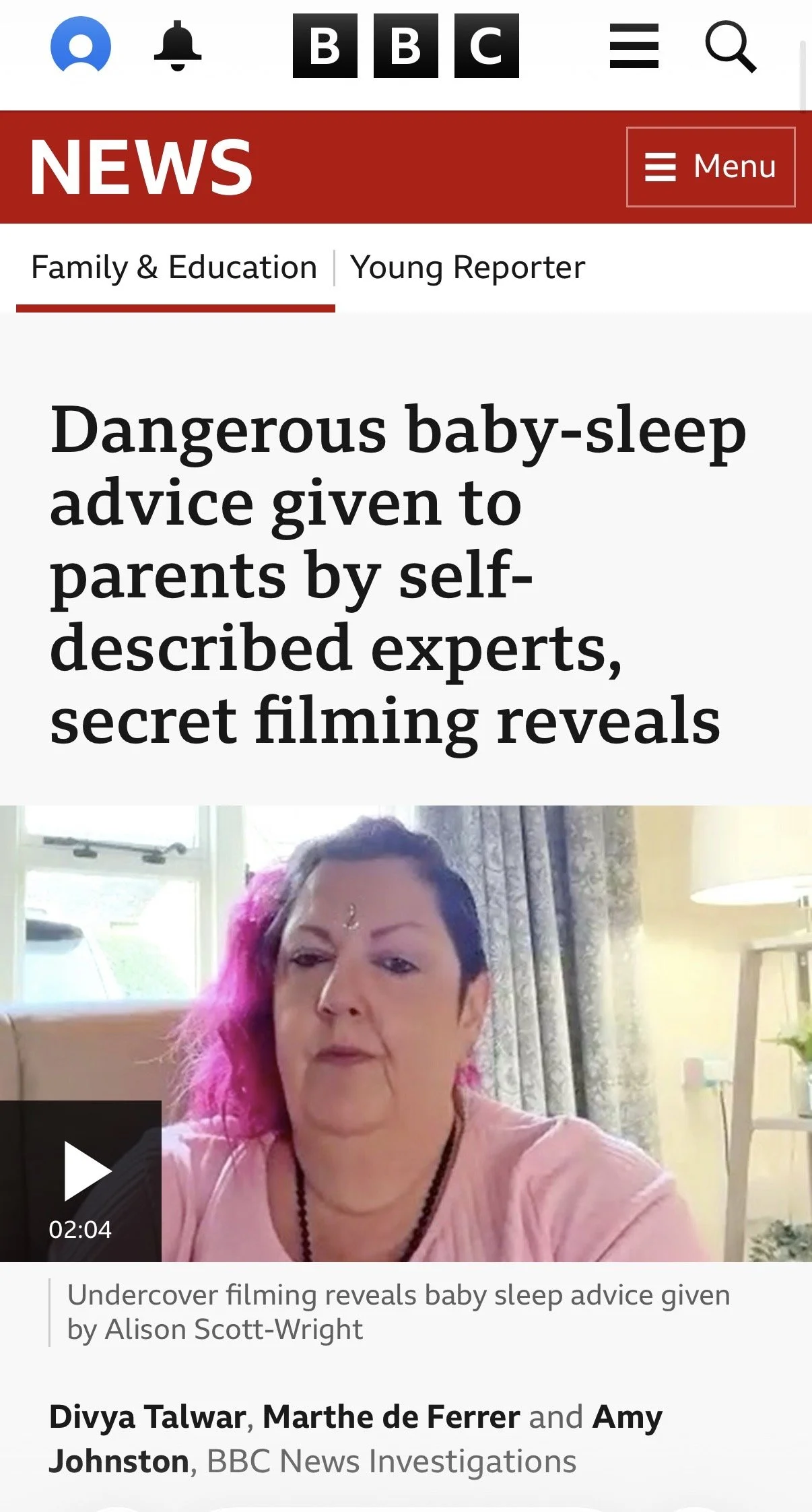
BBC Investigation
On Tuesday 5th May 2026, the BBC News Investigations team revealed the results of their probe into the unregulated world of infant sleep ‘experts’: https://www.bbc.co.uk/news/articles/ce84e1vn1l2o
“Some self-described infant sleep experts are giving advice that could put babies at risk of serious harm and even death, medical professionals have told a BBC investigation.
Health Secretary Wes Streeting has said the government plans to close this loophole across the U.K., by restricting individuals from using the term ‘nurse’ to describe themselves, unless they are properly qualified. It follows an inquest into the death of football manager Steve Bruce’s four-month-old grandson Madison Bruce Smith. A coroner concluded the baby had died, “whilst asleep in his cot having been placed prone in an unsafe sleep position” by someone who described themselves as a maternity ‘nurse’. Streeting told the BBC that "dangerous misinformation dressed up as expert advice is putting babies' lives at risk - and it must stop".
This sector is totally unregulated
For decades, my colleagues and I have watched with growing concern as unqualified individuals - often with large social media followings and who charge significant fees - offer advice to new parents that contradicts established, evidence-based guidance from leading health organisations such as the NHS, the American Academy of Pediatrics, the WHO, and UNICEF.
Parents are frequently encouraged to follow practices such as leaving babies to cry, feeding to rigid schedules, stopping breastfeeding prematurely, restricting maternal diet, medicating infants unnecessarily, and even - as in one case I heard of recently - substituting water for milk at night to prevent “reliance on comfort’. These recommendations not only lack evidence but can negatively impact a child’s health and wellbeing and parental confidence. At the same time, parents are often warned that responding sensitively to their baby’s needs will “create a rod for their own back” and lead to long-term sleep problems. In fact, decades of research clearly show that this is not the case. On the contrary, responsive, loving care is fundamental to the development of secure attachment and healthy emotional outcomes. As highlighted in this UNICEF leaflet: “When babies’ needs for love and comfort are met, they will be calmer and grow up to be more confident. You cannot spoil your baby with too much love”:
https://www.unicef.org.uk/babyfriendly/wp-content/uploads/sites/2/2018/04/happybaby_leaflet_web.pdf
My client’s experience with a so-called maternity ‘nurse.’
A client of mine contacted me when the findings of the inquest into the tragic death of baby Madison were first reported in March 2026. She still feels very upset about her own experience with a so-called maternity ‘nurse’ she hired after the birth of her first son. My client felt shocked but not surprised that the maternity ‘nurse’ who gave such dangerous advice to baby Madison’s parents works for the same company as the person she hired. My client has kindly given me permission to share the email she has just written to the BBC News Investigations team about her experience.
My client’s email to the BBC News Investigations team
Subject: Thank You for Highlighting an Urgent Issue - My Personal Experience
Date: 5 May 2026 at 09:53:15
To: ParentingInvestigation@bbc.co.uk
Dear Divya and the BBC team,
I am writing to thank you for your recent article raising awareness about unregulated baby sleep consultants and maternity care practices. This is an issue incredibly close to my heart, and I truly appreciate you bringing it into the public conversation.
I am a mother of two young sons, and my experience with a well-known, high-profile maternity nurse - someone who often works with celebrities and charges a significant fee - was one of the most distressing periods of my life. At the time, I believed I was hiring someone to support me in caring for my newborn and to help guide me through breastfeeding, something I had long hoped and planned for.
Instead, the experience left me traumatised.
The advice I received was not only misguided but, in my view, dangerous. I was encouraged to let my baby cry for extended periods - sometimes hours - without comfort, and was told I needed to ignore it and leave the house. My breastfeeding journey was completely derailed. I was pushed to pump and provide bottles so that feeds could be measured in ounces, rather than supported to feed my baby naturally and responsively.
During this time, I became seriously unwell on multiple occasions. I developed severe mastitis that went unrecognised and unsupported, leading to hospitalisation.
Even then, the guidance I received remained focused on control and routine, rather than my health or my baby's wellbeing.
When I became pregnant again just eight months later, I was determined to do things differently. With the support of a Breastfeeding Counsellor I had build a close relationship with, I rebuilt my understanding and confidence. With my second son, I followed a responsive, nurturing approach-feeding on demand, keeping him close, and co-sleeping safely. The difference was profound. We have a strong, secure bond, and that experience has been deeply healing for me.
However, I have also had to work incredibly hard to repair the bond with my first son and process the guilt and trauma from those early months. No mother should be made to feel that harmful practices are normal or necessary.
I am sharing my story because I know I am not alone. Too many women are led to believe that this kind of treatment is acceptable, particularly in an industry that remains largely unregulated. I also understand that the maternity nurse I worked with has been referenced in recent reporting relating to the training of another nurse involved in a tragic case, involving the death of a baby in her care. This only deepens my concern that stronger oversight and accountability are urgently needed.
I do not want my experience to be in vain. If sharing my story can help protect other families or contribute to meaningful change, I would welcome that. I would be more than happy to speak further or have my experience published if it would support your ongoing reporting on this issue.
Thank you again for shining a light on something so important.
Warm regards,
J.B.
Why has it taken a tragedy for action to be taken?
Several of my colleagues have said that they are experiencing a complex mix of emotions today: relief that this sector may finally be subject to proper regulation, alongside deep sadness that it has taken the death of a baby for this to happen finally.
Links:
https://www.facebook.com/share/1LusyPHHPs/?mibextid=wwXIfr
https://www.facebook.com/reel/2061833941433035
https://www.instagram.com/reel/DYL_qENtW4C/?igsh=MXZ6NGRmMW5rNmsyaQ==
https://www.bbc.co.uk/news/articles/ce84e1vn1l2o?fbclid=IwY2xjawRnDClleHRuA2FlbQIxMQBicmlkETEwWmRNMXhtN0NUaXBiMDVzc3J0YwZhcHBfaWQQMjIyMDM5MTc4ODIwMDg5MgABHvAcq4Q5stR48P0OFLHD8r_EEOFW6zOqAWVfEWUGsoadcZfC1ipev4tpY2cU_aem_dUymrwTzBb4tBRcYPOE_Eg
https://www.cordeliauys.co.uk/kathryn-stagg-on-the-importance-of-responsive-parenting
Trusted, evidence-based websites:
https://www.cordeliauys.co.uk/recommended-websites-for-infant-feeding-and-parenting