My experience of natural term breastfeeding
by Gwyneth Ramsay-Connell
January 2026
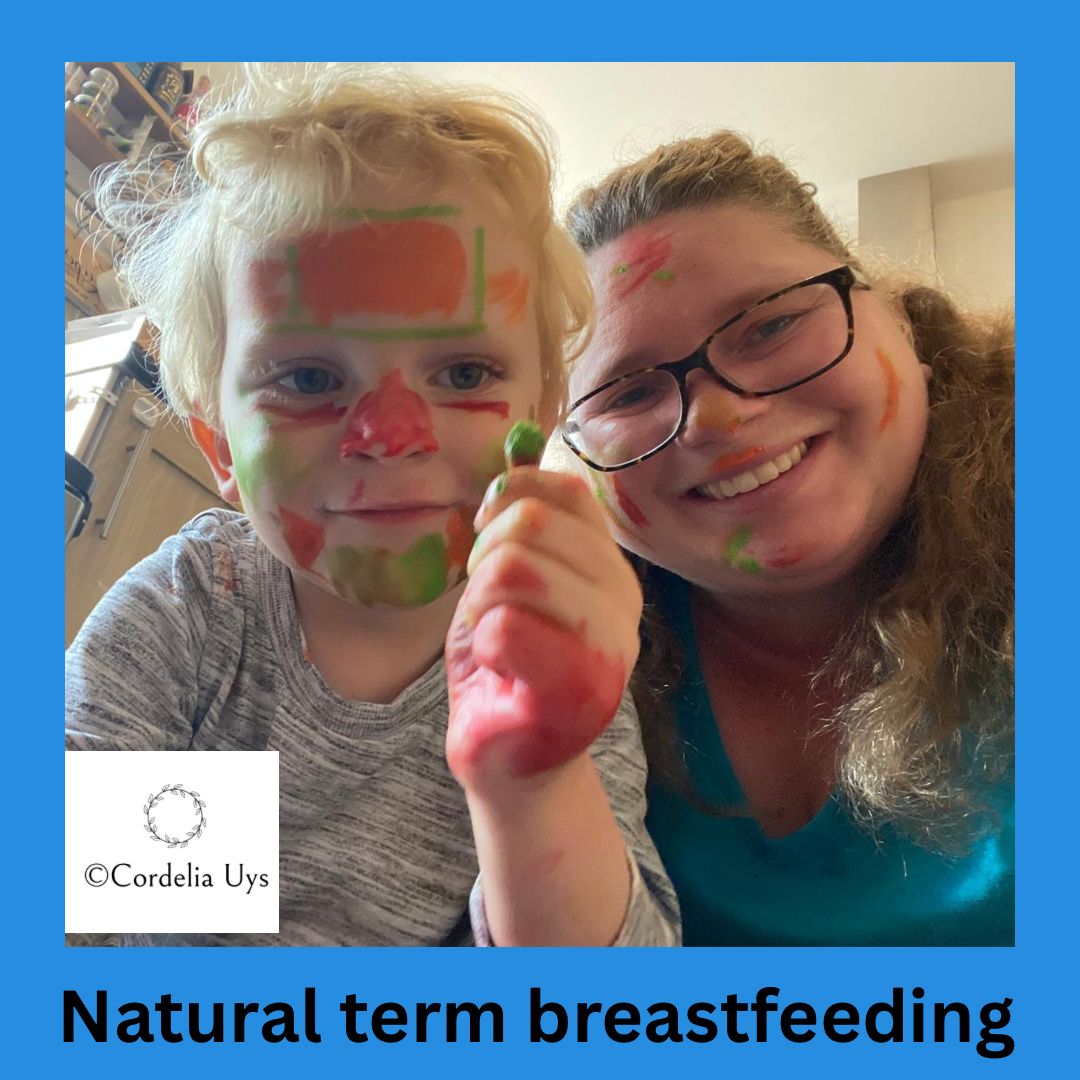
Natural term breastfeeding is something that is still controversial in our society. Of course, not everyone can, or will want to breastfeed to natural term. I hope if you are reading this and are considering it, this article will provide an honest account of the ups and downs, with links to resources I relied on throughout my journey. And if you can’t, or don’t want to breastfeed to term, but know someone who is on that path, I hope reading this will prove informative and help reduce the barriers and judgement that women face. We’re not crazy hippies, just normal women with normal jobs doing what’s biologically normal and right for our families.
I set myself an 8-week goal to establish breastfeeding and gave myself permission to stop after the first vaccinations if it wasn’t working. I had NO idea I would still be breastfeeding a 4-year-old and I probably would have thought women who did were weird if I had known such a thing existed. I was unaware that in many cultures it is totally normal. I was lucky enough to attend two antenatal classes led by Cordelia, so felt like I really understood the science and theory of breastfeeding before my baby arrived. My main takeaway was that breastfeeding is a learned skill and to seek help if needed.
That help arrived when my son was 73 hours old. I knew from the classes that I wasn’t getting a deep enough latch and as a result my nipples were sore and raw. I honestly don’t know if I would be here today writing about natural term breastfeeding if I hadn’t arranged for an IBCLC lactation consultant to come to my home that Sunday morning. In hospital my son was shoved on to me in the cross-cradle hold; the lactation consultant explained that with my body type, and him being a large baby, rugby hold might be better. The relief was instant, and after a bit of practice with the rugby hold and the side lying position, we figured it out!
After couple months, I saw an advert to train as a peer supporter with the Camden baby feeding team and signed up straight away. I admire every woman seeking support with breastfeeding, whether she is exclusively breastfeeding or mixed feeding, and whether her journey lasts days, weeks, months or years.
Working with the women from the Camden baby feeding team, having their support and the benefit of their wisdom and experience during my first year of breastfeeding, contributed enormously to my feeling able to continue. I was tempted to stop at 9 months due to teething. Two nights in a row my son chewed on my nipples so badly I had to go and stand in the bathroom and breathe deeply; it felt like a violation. The next morning I turned up to volunteer, sleepless and upset and was reminded of teething gels and powders. Although not evidence-based so I can’t technically recommend them, they saved my breastfeeding journey, along with Cordelia’s article on biting.
After 11 ½ months I returned to work. I was ecstatic to learn that from about 9 months most breastfed babies can do an 8 hour working day with just solids and water, though they may breastfeed more at night to compensate (a process called reverse cycling). I managed on broken sleep and found an amazing married couple as childminders (it honestly felt like sending him to an aunt and uncle).
At 12 months you no longer need to feed responsively and can set nursing boundaries, but for me going back to work was enough of a boundary. It was liberating to use my brain on adult things again, to wear what I wanted without worrying about boob access and not to have to monitor a small child constantly. Going back to work enabled me to continue breastfeeding as it gave me a break during the day.
The most difficult thing for my husband and me was the ‘reunification feed’ when we got home. Yes, it was lovely to re-connect and probably had psychological benefits for my son after being away from me for the day, but it also meant the burden of cooking fell largely on my husband as neither of us wanted to wait for dinner. Luckily, at around 18 months, my son dropped this feed of his own accord.
Around 15-20 months was another period I seriously considered stopping due to poor nursing manners and toddler gymnastics. The nipple twiddling, pinching and toddler gymnastics were not pleasant, but I think stopping would have been traumatic for both of us and it didn’t feel right like the right time. I took inspiration from useful articles on weaning, unwanted behaviour and nursing boundaries. And I started introducing sign language accompanied by the phrase ‘milk please’ to get him used to asking instead of just helping himself. It meant I could say ‘no’ or ‘later’ if I was busy. I would say ‘hands off’ then ‘hands off or we stop the feed’ if he did anything like twiddling or pinching and followed through if he didn’t stop. Things improved and I was happy to continue.
I never fully night weaned, as I felt there was obviously a need that needed to be met if my son woke up. But I did start balancing my need for sleep with my son’s needs and introduced a 10 second countdown to signal when a feed was ending. It took about 2/3 nights to introduce, but it worked well. I can honestly say the best sleep I’ve had in years was when he was down to one night feed. The release of melatonin and tryptophan would knock me right out after a feed. When he eventually slept through the night at around 2 years and 3 months, my sleep actually deteriorated. If I wake in the night now there are no hormones to help knock me out so I sometimes get less sleep than I did in those days.
During that period, my son was ill with a chest infection and rushed to hospital in an ambulance. I genuinely believe if it hadn’t been for the co-sleeping aspect of breastfeeding his life may have been at risk. That time, and every other time he has been unwell, I’ve been so grateful for the safety net that breastmilk provided.
There have been other highs: the smiles that only I got in the night, the funny ways he would describe the taste (strawberries apparently), the feeling that you can be a rubbish parent some days, and make mistakes, but you can repair it all with one feed.
I learnt more about other cultures’ attitude to breastfeeding, how our society is WEIRD, and the physical and mental health benefits of breastfeeding beyond infancy (also see Cordelia’s article.)
One thing a lot of people worry about is whether they can leave their older baby/toddler if they’re breastfeeding. There was recently controversy in the media when Kourtney Kardashian left a party early due to ‘being on a breastfeeding schedule’ and not wanting to leave her 18-month-old for more than 6 hours. While this may be what was right for Kourtney, it is certainly not an evidence-based rule (and one most working mothers will find impossible to follow). I worry these stories put women off breastfeeding beyond infancy, or even beyond returning to work.
My son had a one-off fluke when he slept through the night at 19 months, so I called my mum and asked if she would take him overnight. They have a special bond, and she was the only one from whom he would ever take a bottle, so we decided to trial having a night away from him. Instead of booking a fancy restaurant or tickets to the theatre, we bought a new hoover and deep cleaned our flat without a toddler underfoot. I was prepared to jump in a taxi if it all went pear-shaped. No money was spent on fancy plans, so there was no pressure to make this a big night.
It was a success: he slept through with my mum. I was able to hand express a little for comfort and from then on, we were able to leave him occasionally and still resume our breastfeeding relationship when reunited.
I was ecstatic to reach the two-year milestone, and had some jewellery made with my breastmilk to mark it. I’m glad I did as I lost the ability to hand express as feeds reduced, maybe around the 3-year mark. And they did reduce, slowly. Eventually it was just a bedtime and first thing in the morning thing.
We stopped feeding in public before 2 years, so I could wear whatever I wanted outside of home. At some point my son dropped the bedtime feed most nights too and would fall asleep with just a cuddle. We went from around 20 feeds a week, to around 14, and then 5-10. I did think about stopping sometimes but there was no reason to, no benefit, nothing to be gained. Breastfeeding took up less and less of my headspace, which became filled with numbers, the alphabet and dinosaurs instead. But we did chat about stopping, and he became obsessed with The Story of Jessie’s Milkies (by Emma Pickett) for a while, though he never seemed to understand it applied to real life. Since it was taking up less space in my head, it made no sense to me to give it more headspace by engaging in parent-led weaning. Sometimes the path of least resistance is actually the right one.
In August 2025, 2 months before my son’s 4th birthday, we moved house, and my in-laws took my son for 10 days. At this point I’d lost the ability to hand express, and I thought he might forget how to feed. The separation was necessary for many practical reasons and on top of that, my husband and I needed some alone time after a very stressful conveyancing process. I felt like if those circumstances brought an end to our journey, so be it; life isn’t perfect.
But to my surprise feeds resumed, maybe around 3-4 times a week. A few weeks later he started becoming aggressive during feeds and complaining that the milk was taking a long time to come. I didn’t want my natural term goal to be taken from me due to lack of supply and aggression, but stopping would have been for the best had the behaviour not improved. I did the ‘hands off or we stop the feed’ move again and that seemed to work.
Then Christmas came and he didn’t breastfeed for 5 days because of all that was going on; then he was feeding just 2-3 mornings a week, and then around mid- January he stopped asking and it was about two weeks before I realised. I offered once and he wasn’t interested. So I think we’re done. And I feel okay. Many women experience low mood due to a drop in oxytocin, but I guess it’s been so gradual that hasn’t happened. I would say the end hasn’t come with any particularly strong feelings, maybe just a small amount of pride and happiness for what we had, a little relief that it’s over, and a bit of sadness that my baby is growing up.
Looking back, I would say not to worry about long term goals. Just take it one day at a time; if you meet challenges, seek help. DO NOT let a pharmacist or doctor tell you that you can’t breastfeed when taking certain medications without checking first with the BFN Drugs in Breastmilk Service. Look for good quality breastfeeding support from someone with proper training ( https://lcgb.org/why-ibclc/whos-who-in-breastfeeding-support-and-lactation-in-the-uk/ ) and talk things through with a peer supporter, breastfeeding counsellor or IBCLC lactation consultant before making the decision to stop. You can always make that decision on another day. And if you never make that decision, if you leave it to your child to decide, you can keep hold of something special, magical and most importantly biologically normal for just that little bit longer.
Resources:
Emma Pickett: Makes Milk podcast: https://www.emmapickettbreastfeedingsupport.com/makesmilkpod
Emma Pickett: The Story of Jessie’s Milkies: https://www.emmapickettbreastfeedingsupport.com/blog/my-new-book-the-story-of-jessies-milkies
Cordelia Uys: https://www.cordeliauys.co.uk/myresources
BfN Drugs in Breastmilk: https://www.breastfeedingnetwork.org.uk/drugs-factsheets/
The Breastfeeding Network (BfN): https://www.breastfeedingnetwork.org.uk/
La Leche League (LLL): https://laleche.org.uk/
Association of Breastfeeding Mothers (ABM): https://abm.me.uk/
GP Infant Feeding Network (GPINF): https://gpifn.org.uk/