PACED BOTTLE-FEEDING
by Cordelia Uys
Breastfeeding Counsellor
April 2026
Whether your baby is exclusively bottle fed or mostly breastfed with the occasional bottle of expressed milk, how you offer the bottle can make a real difference.
Paced bottle feeding is a gentle technique that allows your baby to be more in control of their feed, much like they would be at the breast.
When babies are held in the traditional reclined bottle feeding position, a combination of gravity and their natural sucking reflex means the milk tends to be delivered fast.
By holding the bottle horizontally and pausing regularly - pulling the bottle down to interrupt the flow, but not taking the bottle out of your baby’s mouth - you give them time to listen to their body and recognise when they've had enough.
Concerns over giving breastfed babies a bottle
There used to be a lot of anxiety about breastfed babies being given a bottle, even if it contained expressed breastmilk, because after just a couple of feeds from a bottle, babies would often start rejecting the breast. It was believed this was due to nipple confusion, meaning that babies developed a preference for the teat of a bottle, because it is much firmer and longer than a mother’s nipple.
Paced bottle-feeding protects breastfeeding because it slows the flow
However, it is now believed that babies start to refuse the breast primarily because they get used to the fast flow of milk from a bottle and get frustrated when milk comes more slowly from the breast. It has been observed that when parents are shown a technique known as paced bottle-feeding, which slows down feeds considerably, babies are much less likely to reject the breast, even when given several bottles a day.
Paced bottle-feeding also helps prevent overfeeding
Paced bottle-feeding is also recommended for formula-fed babies because it helps to prevent overfeeding. If you bottle-feed a baby while holding them in the traditional reclined bottle-feeding position, a combination of gravity and the baby’s sucking reflex means it’s very likely they will drink more milk than their tummy can comfortably fit. Paced bottle-feeding allows the baby to drink at their own speed, respects the natural breaks that babies like to take, and makes it easier for parents to tell when their baby is full.
Babies are able to self-regulate
Babies have a natural ability to self-regulate: as long as they’re in control, they will stop feeding as soon as they are full. But when babies are regularly fed large volumes of milk, it stretches their stomach, which can affect their ability to self-regulate and puts them at risk of becoming overweight later on in life. At the moment, in the UK, more than 1 in 5 children are overweight or obese when they begin primary school. It has been estimated that in at least 20% of cases, this is due to being overfed via the bottle as babies.
How to practise paced bottle-feeding:
There are several films online explaining paced bottle-feeding. Here are the recommended steps:
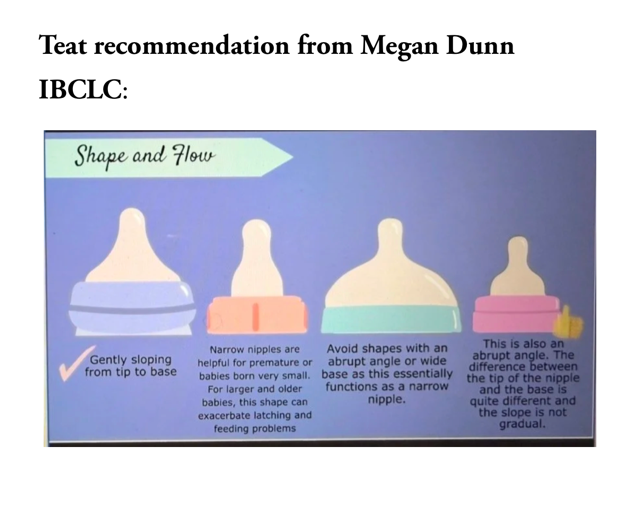
Use a slow-flow, newborn teat.
Use a bottle that has a smaller diameter and doesn’t have a ‘waist’. When a bottle has a large diameter, parents need to tilt the bottle sooner, meaning the teat fills with milk.
Hold your baby against your body, supporting their head either in the crook of your arm or with your hand at the base of their neck. Support their body so they aren’t slouched and their head can tilt back a bit.
Make sure your baby is sitting more or less upright and isn’t bent at the waist.
Encourage your baby to gape their mouth wide by gently running the bottle teat from the tip of their nose to their bottom lip. Don’t force the teat into their mouth.
Make sure your baby is taking a big mouthful of the teat, not just the tip.
If your baby’s lips are curled in, gently use your finger to coax them out so they flange round the teat. Sometimes it can help to gently pull the baby’s chin down a bit to get a bigger gape.
For breastfed babies: for a few seconds at the start of a feed, hold the bottle down so the baby sucks on the teat before there’s any milk in it. On the breast, babies need to stimulate milk flow.
Hold the bottle horizontal with the floor, so that there is half milk, half air in the teat. Please don’t worry about your baby swallowing air. In fact, paced feeding helps to prevent wind: as Hannah Croft IBCLC explains here, contrary to popular belief this doesn’t make babies swallow air. In fact, paced feeding helps prevent this:
https://www.instagram.com/reel/DNnzwp9ttb9/?igsh=MWtsMHVuaHFhMDBqNg== )
Every 30 seconds or so, or when you see your baby taking a natural break, tilt the bottle down so that you stop the flow of milk, but don’t pull the bottle out of your baby’s mouth. Pulling the bottle out of their mouth isn’t necessary and will probably upset the baby.
Count to about 30 seconds. When your baby starts sucking again, tilt the bottle back up.
Repeat until your baby no longer starts sucking during breaks.
Stop giving the bottle as soon as your baby no longer shows interest.
Never try to persuade a baby to finish a bottle.
Video explaining paced feeding:
https://www.youtube.com/watch?v=GNMm4Twhvbs
Some benefits of paced feeding include:
Helping to prevent overfeeding.
Helping to protect babies’ ability to self-regulate.
Supporting babies to develop their own natural feeding rhythm.
Reducing the risk of tummy discomfort and vomiting.
Reducing the risk of babies developing a preference for a faster flow and consequently…
protecting against breast refusal.
Feeding isn't just about nutrition - it's also about connection and learning to read your baby's cues. Slowing things down can help make bottle feeding more comfortable and responsive, as well as protecting breastfeeding.
N.B. When breastfeeding is going well, the recommendation is to wait roughly 4-6 weeks before doing any pumping:
If you are breastfeeding your baby, and it’s going well, it’s recommended to wait until around 4 to 6 weeks before doing any pumping. This is because it takes approximately 6 weeks for a mother’s breasts to work out how much milk her baby needs. Pumping before her milk supply is established can put a mother at risk of developing blocked ducts and mastitis. (See my article: https://www.cordeliauys.co.uk/expressing-after-6-weeks-when-breastfeeding-is-going-well )
However, in certain circumstances, pumping earlier than 6 weeks can be very helpful:
If a baby is born early or premature
If a baby isn’t able to latch
If a mother can’t breastfeed due to pain and/or damage
If a mother needs to increase her milk supply